



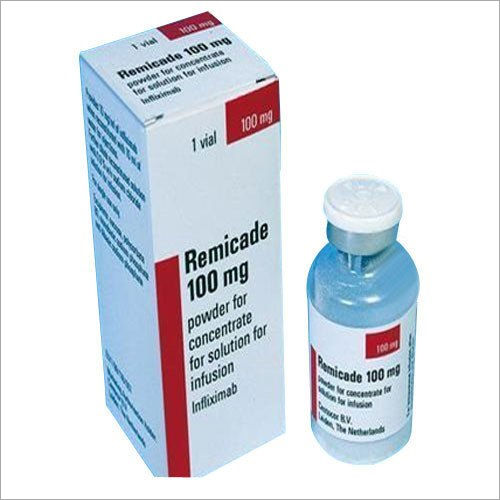
100mg Remicade
17000 INR/Pack
Product Details:
- Brand Name Remicade
- Life Span Refer to expiry date on pack; typically 24 months from the date of manufacture
- Dosage Form Injection (Powder for Reconstitution)
- Packaging Type Glass vial with flip-off cap in a carton box
- Pacakaging (Quantity Per Box) 1 vial per box
- Salt Composition Infliximab
- Indication Rheumatoid Arthritis, Crohns Disease, Ulcerative Colitis, Ankylosing Spondylitis, Psoriatic Arthritis, Plaque Psoriasis
- Click to View more
X
100mg Remicade Price And Quantity
- 17000 INR/Pack
- 50 Pack
100mg Remicade Product Specifications
- Remicade
- Adults and Pediatric patients
- As directed by Physician
- Adults and Children with Autoimmune Diseases
- Drug Solutions
- Immunosuppressant / Anti-TNF Alpha Monoclonal Antibody
- Infliximab 100mg
- Refer to expiry date on pack; typically 24 months from the date of manufacture
- Injection (Powder for Reconstitution)
- As directed by physician, administered as intravenous infusion
- 1 vial per box
- Glass vial with flip-off cap in a carton box
- Liquid
- 1 vial
- Infliximab
- Cool Dry Place
- Rheumatoid Arthritis, Crohns Disease, Ulcerative Colitis, Ankylosing Spondylitis, Psoriatic Arthritis, Plaque Psoriasis
- Imported
- Intravenous Infusion only
- Use immediately or within 3 hours if refrigerated at 2C - 8C
- Approx. 149 kDa
- Prescription only
- Reconstitute each vial with 10 mL sterile water for injection
- Hypersensitivity to Infliximab or murine proteins. Active severe infections.
- Off-white to pale yellow lyophilized cake or powder
- L04AB02
- Infusion reactions, infections, headache, abdominal pain, rash
100mg Remicade Trade Information
- 10000 Pack Per Week
- 24 Hours
- As per requirement
- Asia, Australia, North America, South America, Eastern Europe, Western Europe, Middle East, Africa, Central America
- All India
Product Description
10mg Remicade is a monoclonal antibody that is used for the treatment of rheumatoid arthritis. It is also used for the treatment of severe or disabling plaque psoriasis. The medicine should be used as per the prescription of an expert medical practitioner. Due to its efficacy and top-notch chemical composition, 10mg Remicade is one of the most prescribed medicine for the aforementioned ailments.
Specification
|
Manufacturer |
Janssen |
|
Strength |
100 mg |
|
Packaging Size |
1 mL |
|
Packaging Type |
Vial |
|
Composition |
Infliximab 100 mg |
|
Usage/Application |
Rheumatoid Arthritis, Psoriatic Arthritis |
How Remicade Works
Remicade contains infliximab, an anti-TNF alpha monoclonal antibody that helps reduce inflammation by blocking the action of tumor necrosis factor-alpha in the body. This targeted approach contributes to symptom relief in various autoimmune conditions while helping to prevent progression and joint damage.
Intravenous Administration and Preparation
Remicade is administered only as an intravenous infusion. Each vial is reconstituted with 10 mL of sterile water for injection before use. The solution, once prepared, should be used immediately or within three hours if stored in a refrigerator. Administration must be carried out in a healthcare setting by trained professionals.
Who Can Benefit from Remicade
The use of Remicade is recommended for both adults and children who suffer from certain autoimmune diseases. It is particularly beneficial for conditions like rheumatoid arthritis, Crohn's disease, and psoriatic arthritis, helping individuals achieve better disease control and improved quality of life.
FAQ's of 100mg Remicade:
Q: How is Remicade 100mg administered to patients?
A: Remicade is administered as an intravenous infusion. The lyophilized powder from the vial is reconstituted with 10 mL of sterile water for injection and then infused directly into the bloodstream by a healthcare professional in a clinical setting.Q: What are the steps for reconstituting Remicade before infusion?
A: To prepare Remicade for infusion, add 10 mL of sterile water for injection to each 100mg vial and gently swirl to dissolve the powder. Avoid vigorous shaking. The resulting solution should be used immediately or refrigerated (2C-8C) and used within 3 hours.Q: When should Remicade not be used?
A: Remicade is contraindicated for patients with known hypersensitivity to infliximab or murine proteins, and those with active severe infections. Physicians will evaluate suitability before recommending treatment.Q: What are the possible adverse effects of Remicade infusion?
A: Common adverse effects include infusion-related reactions, infections, headache, abdominal pain, and rash. Patients are monitored during and after the infusion to manage any adverse symptoms promptly.Q: Where should Remicade vials be stored before use?
A: Remicade vials should be stored in a cool, dry place and protected from light. After reconstitution, the solution should be used immediately, or if necessary, kept refrigerated at 2C-8C for up to 3 hours.Q: What are the benefits of using Remicade for autoimmune diseases?
A: Remicade effectively reduces inflammation and disease activity in autoimmune disorders, potentially leading to symptom relief, improved physical function, and prevention of long-term joint and tissue damage.Q: Who is suitable for receiving Remicade therapy?
A: Remicade is suitable for adults and pediatric patients diagnosed with conditions such as rheumatoid arthritis, Crohn's disease, ulcerative colitis, ankylosing spondylitis, psoriatic arthritis, and plaque psoriasis, as determined by a physician.Tell us about your requirement

Price:
Quantity
Select Unit
- 50
- 100
- 200
- 250
- 500
- 1000+
Additional detail
Mobile number
Email


SPARK LIFESCIENCES
GST : 24ACKFS9546B1ZZ
Contact Details

- B No. 220, Samanvay Silicon, Beside Datta Mandir, Opposite Kalyan Cafe, Sayajigunj,Vadodara - 390020, Gujarat, India
- Phone :08045475752

- Mr Gaurang Patel (Partner)
- Mobile :08045475752

 Send Inquiry
 Send SMS
 Call Me Free
SPARK LIFESCIENCES
All Rights Reserved.(Terms of Use)
Developed and Managed by Infocom Network Private Limited.
Developed and Managed by Infocom Network Private Limited.

